Concrete Construction & Contraction Joints
Concrete construction and contraction joint detailing for slabs on ground - a typical detail sheet of seven joint types with sealant, dowel, and waterstop specifications.
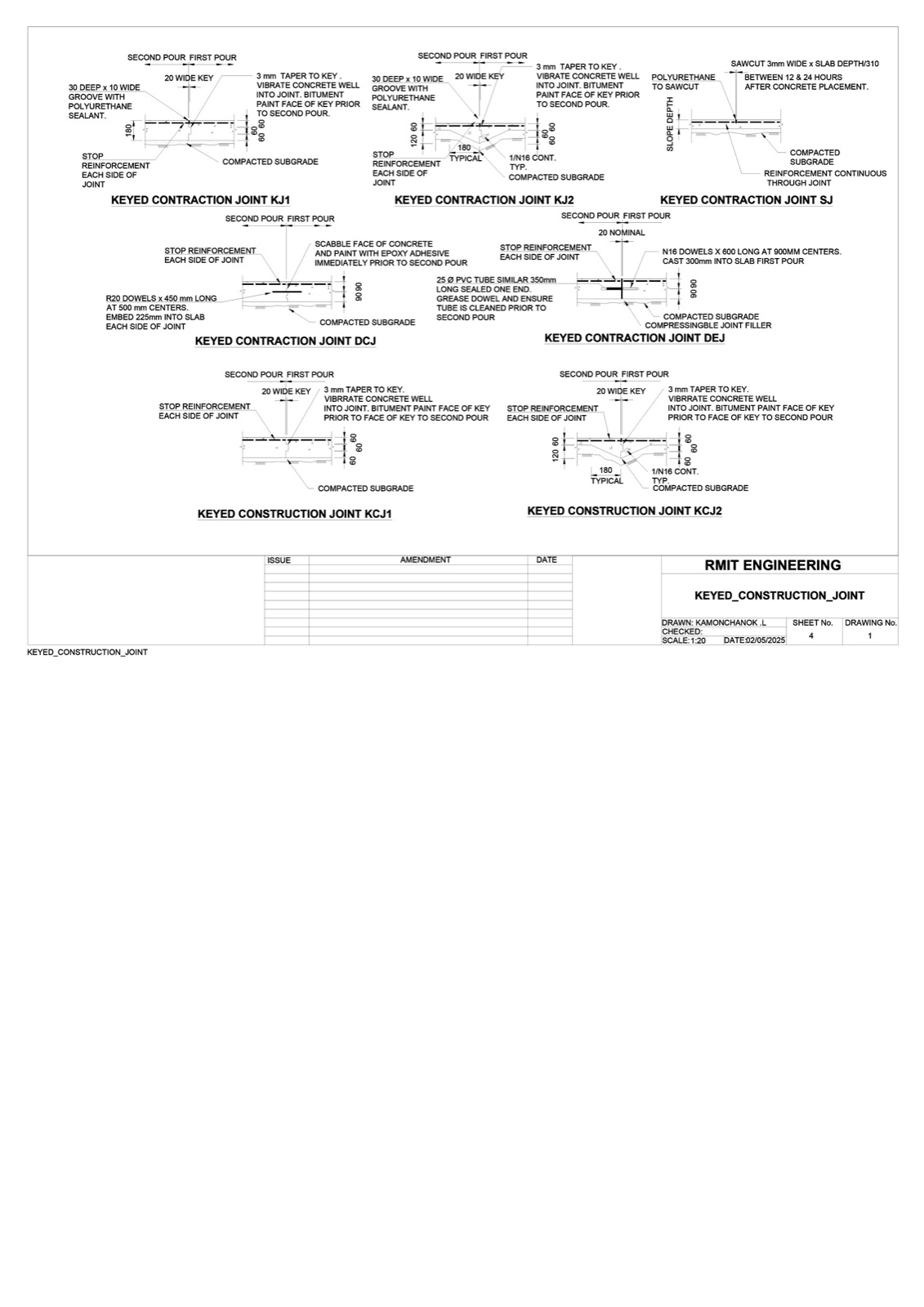
- - Keyed contraction joint details (KJ1, KJ2, SJ)
- - Dowelled contraction joint details (DCJ, DEJ)
- - Keyed construction joint details (KCJ1, KCJ2)
- - Sealant and waterstop specification
About the project
A concrete detailing exercise covering the joint types used in slabs on ground, paving, and industrial concrete floor construction. The drawings represent typical Australian engineering office detail sheets - the kind of standard details a construction set carries on every project.
Joint types documented
- KJ1 / KJ2 - Keyed contraction joints with 20 mm keys, polyurethane sealant grooves, reinforcement stopped each side, and compacted subgrade detail
- SJ - Sawcut contraction joint with polyurethane sealant, sawcut depth at slab depth divided by 3.10, made between 12 and 24 hours after concrete placement, continuous reinforcement through joint
- DCJ - Dowelled contraction joint with R20 dowels at 450 mm long at 500 mm centres, embedded 225 mm into slab each side, epoxy adhesive on scabbled face
- DEJ - Dowelled expansion joint with N16 dowels at 600 mm long at 900 mm centres, 25 ∅ PVC tube sleeve, compressible joint filler
- KCJ1 / KCJ2 - Keyed construction joints with 20 mm wide keys, polyurethane sealant, reinforcement stopped each side
Drafting standards
Standard 1:20 scale detail format, AS-compliant titleblock, plan and elevation views per joint type, sealant and dowel callouts following typical engineering office conventions. Drawn at the level of detail that goes onto a real project’s detail sheet without further work.
What this demonstrates
The concrete detailing fluency that civil and structural drafting offices need - joint design representation, sealant specification, and the kind of careful detail drafting that prevents construction defects on actual sites.